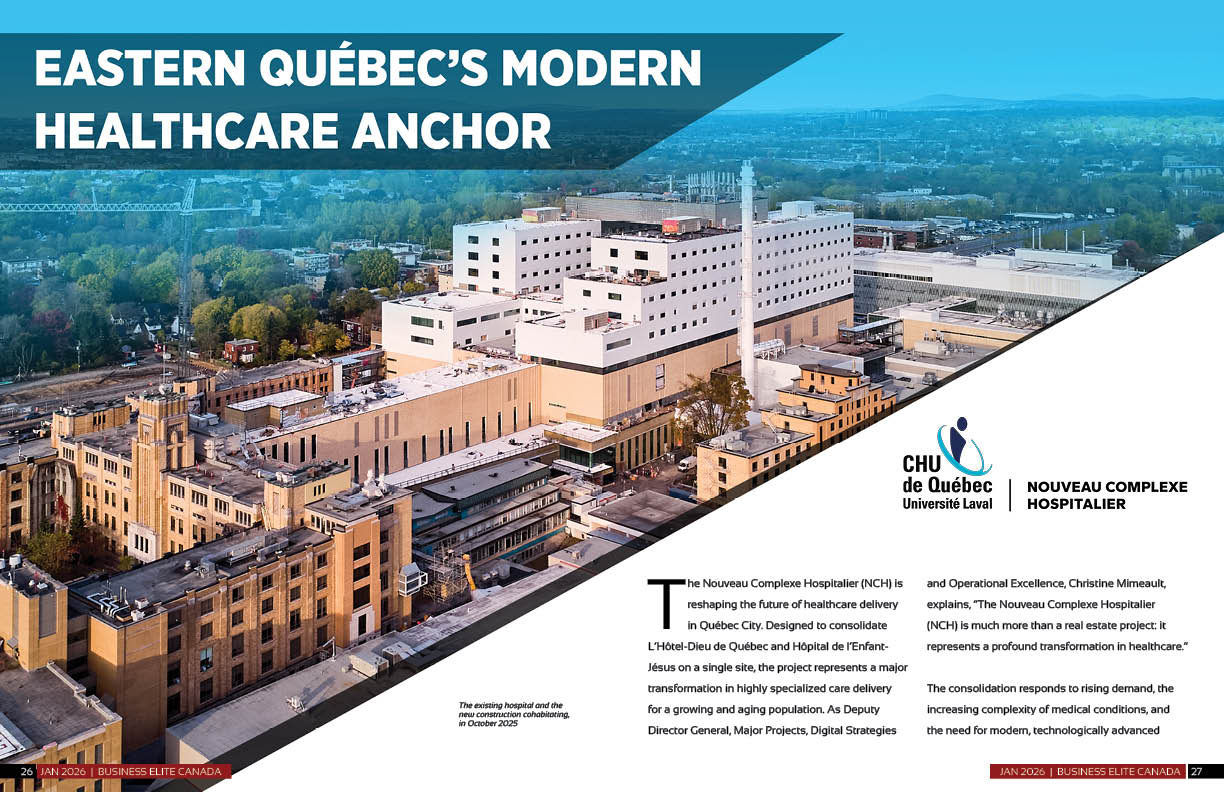
The Nouveau Complexe Hospitalier (NCH) is reshaping the future of healthcare delivery in Québec City. Designed to consolidate L’Hôtel-Dieu de Québec and Hôpital de l’Enfant-Jésus on a single site, the project represents a major transformation in highly specialized care delivery for a growing and aging population. As Deputy Director General, Major Projects, Digital Strategies and Operational Excellence, Christine Mimeault, explains, “The Nouveau Complexe Hospitalier (NCH) is much more than a real estate project: it represents a profound transformation in healthcare.”
The consolidation responds to rising demand, the increasing complexity of medical conditions, and the need for modern, technologically advanced facilities. The long-term vision prioritizes quality of care, innovation, and sustainability while strengthening the CHU de Québec–Université Laval’s role as a university centre for research and teaching. The project is one of the largest clinical and real estate undertakings currently underway in the province.
Among the immediate gains are expanded hospital capacity, more private rooms, additional operating rooms, and improved emergency services. “The NCH brings tangible benefits for patients, healthcare professionals, and society: increased hospital capacity, improved patient experience through private rooms and streamlined care pathways, reduced treatment delays, and better care coordination,” says Mimeault. Specifically, the project will make it possible to accommodate 40,000 additional patients, 10,000 more visits in the emergency room, and 5,000 more surgeries annually. Construction began in 2017, and seven of the ten major components have already opened, thanks to a pavilion-based approach that enables activation as buildings are completed.
Efficiency and Innovation
The project is designed to optimize both clinical and operational performance. Mimeault highlights the role of Lean practices and advanced digital tools in driving efficiency across the future hospital. “These gains are accompanied by process optimization through the integration of Lean practices, reducing costs and improving service quality.” This includes automated guided vehicles, paperless processes, integrated data systems, and a first-in-Canada clinico-logistique platform that manages all logistics flows.
Innovation extends into clinical spaces as well. The pod-based model at the Centre intégré de cancérologie Pierre-Péladeau brings specialists to patients in a coordinated sequence. “Instead of patients navigating between multiple specialists in a complex care pathway, clinicians come to the patient in an integrated manner,” says Mimeault.
This approach improves care coordination and supports synchronized appointments for multiple treatments in a single day. Artificial intelligence is used in cancer treatments to analyze the disease and develop personalized treatment plans and our research center contributes every day and every week to discovering new treatments in partnership with Université Laval.
The NCH design also aligns with the concept of a healing environment. “By incorporating abundant natural light, soothing colors, artwork, and relaxation areas into its buildings, the NCH contributes to patient recovery and enhances staff quality of life.”
Economic Impact and Long-Term Sustainability
With an investment exceeding $2.66 billion, the NCH is already a major economic engine. “It generates thousands of direct and indirect jobs, stimulates real estate development, and attracts innovative companies,” says Mimeault. The effects extend to new business creation, residential development, and increased regional appeal for medical and scientific talent. In the long term, the project will strengthen the medical research and technology ecosystem, supporting new industrial and academic partnerships. “The NCH construction site creates many local jobs, with an average of 500 to 600 workers on-site each day,” continues Mimeault, adding 500 hundred permanent positions will be created once the hospital is fully operational. Jobs in healthcare are generally well-paid, stable, and on-site, which will contribute to the region’s economy.
“From the very first discussions about the NCH project, it was clear that acquiring advanced medical and digital technologies would be at the heart of decision-making,” says Mimeault. The budget was built accordingly, and an additional $60 million contribution from the Fondation du CHU de Québec made it possible to acquire major equipment such as the MRI-LINAC and the cyclotron. “Innovation is [also] at the heart of the NCH: MRI-Linac, cyclotron, advanced digital technologies.
A Model for Future Healthcare Infrastructure in Québec
As a major public project funded primarily by the Government of Québec, the NCH has followed rigorous provincial approval processes. Adjustments to budgets and timelines were made to respond to market conditions and evolving clinical priorities. The Fondation du CHU de Québec’s $60 million contribution, Mimeault emphasizes, enables the project “to achieve the extraordinary.”
The project is already informing best practices across Québec’s healthcare network. “CHU de Québec–Université Laval provides leadership for the community of practice on major healthcare infrastructure projects,” she says. Lessons learned from each pavilion and each relocation are documented and applied to upcoming phases of work. This includes everything from ventilation system balancing to clinical transformation timelines.
As the hospital approaches full operations, performance indicators will be closely monitored. “Regarding quality of care, we evaluate infection rates, incident and accident reports after relocations, patient and staff experience, the impact and reduction of wait times…, care episode management, and the fluidity of care pathways.”
“The NCH is set to become a catalyst for transformation within Québec’s healthcare network. It embodies a vision where care, research, and teaching converge to deliver high-quality, accessible, and innovative services,” says Mimeault. “As one of Québec’s largest infrastructure investments, the NCH stands as a foundational step toward building “the hospital of today and tomorrow.”
For more information, please visit www.chudequebec.ca/nch