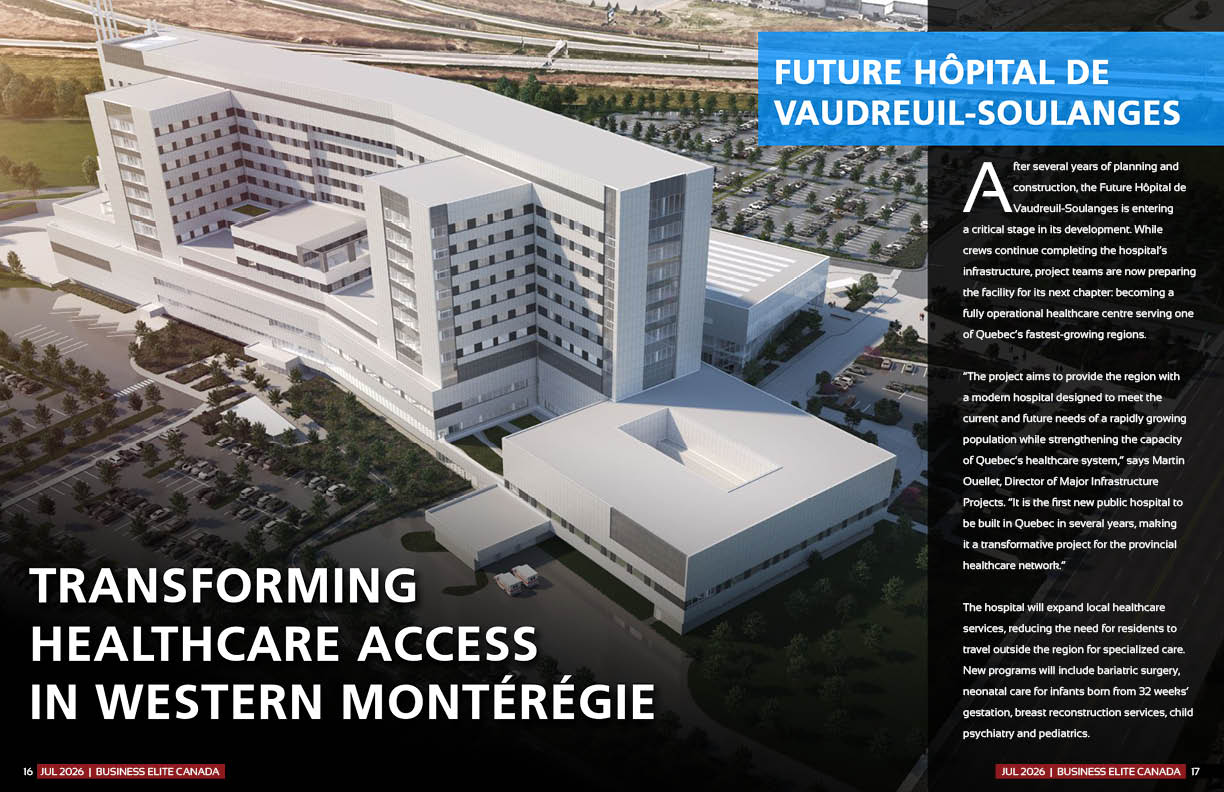
After several years of planning and construction, the Future Hôpital de Vaudreuil-Soulanges is entering a critical stage in its development. While crews continue completing the hospital’s infrastructure, project teams are now preparing the facility for its next chapter: becoming a fully operational healthcare centre serving one of Quebec’s fastest-growing regions.
“The project aims to provide the region with a modern hospital designed to meet the current and future needs of a rapidly growing population while strengthening the capacity of Quebec’s healthcare system,” says Martin Ouellet, Director of Major Infrastructure Projects. “It is the first new public hospital to be built in Quebec in several years, making it a transformative project for the provincial healthcare network.”
The hospital will expand local healthcare services, reducing the need for residents to travel outside the region for specialized care. New programs will include bariatric surgery, neonatal care for infants born from 32 weeks’ gestation, breast reconstruction services, child psychiatry and pediatrics.
Designed Around Regional Growth
“The planning of the project has been directly guided by the demographic projections for Vaudreuil-Soulanges, one of the fastest-growing regions in Quebec,” explains Ouellet. “The new hospital has been designed to meet the healthcare needs of the region while providing residents with access to quality care closer to home.”
The hospital’s service model will create a regional healthcare hub capable of delivering a broader range of services within the community. By increasing local capacity and introducing specialized programs, the facility will improve access to care throughout Vaudreuil-Soulanges and western Montérégie.
Advancing Toward Completion
The project has reached a transition point between construction completion and operational preparation. The hospital campus consists of two primary buildings, Pavilion A and Pavilion B, both progressing through their final stages of development.
“We are now entering the transition phase between the completion of construction and the preparation for the activation of hospital services,” says Ouellet. Pavilion A, a four-storey building, is more than 89 percent complete overall. Structural work and the exterior envelope have been completed, while architectural work has reached 83 percent completion and mechanical and electrical systems are 95 percent complete.
Pavilion B, the larger 13-storey building, has surpassed 80 percent completion. The structure is complete, while the exterior envelope is 92 percent complete and expected to be finished by the end of 2026. Interior architectural work has reached 81 percent completion, with mechanical and electrical systems at 86 percent. Finishing work has begun in several areas, and installation of building-related equipment is continuing.
Infrastructure work surrounding the hospital is also progressing. Parking facilities, roadways and circulation routes are now 82 percent complete, bringing the campus closer to full readiness Overall, construction is progressing very well and continues to follow both the planned schedule and the project’s established budget,” says Ouellet.
Preparing for Hospital Operations
Workforce planning is a key component of this transition. Recruitment has begun for technical teams responsible for operating and maintaining the buildings and equipment, with these employees expected to assume their responsibilities beginning in the summer of 2027. Recruitment efforts are also underway for clinical personnel who will support the gradual activation of hospital services.
“Beyond the construction of the buildings, we are actively preparing for the arrival of the teams, equipment and technologies that will make it possible to provide healthcare services to the community,” says Ouellet. The project team is developing workforce plans and training pathways for each functional unit and specialized piece of equipment. These preparations will ensure that healthcare professionals and technical teams are ready to operate within the new facility.
Collaboration between project partners remains essential during this phase. The team is working with the Société Québécoise des Infrastructures and the construction contractor to support the transfer of knowledge required for the hospital’s ongoing operation and maintenance.
Technology will also play a central role in preparing the hospital for service. Medical equipment delivery and installation planning are underway, alongside deployment of the information technology infrastructure required to support hospital operations.
“The deployment of the IT network will allow the activation of IT rooms beginning in the summer of 2026 and support the commissioning of the building’s mechanical and electrical systems,” explains Ouellet.
Together, these efforts represent the next stage of the project’s evolution as teams prepare for the arrival of the first patients in the summer of 2028.
Building a Long-Term Healthcare Legacy
The coming years will mark a significant transition as construction activities give way to operational readiness. Key milestones include the activation of technological infrastructure, commissioning of building systems and, beginning in 2027, delivery and installation of major medical equipment. The project team will gradually assume responsibility for the facility as preparations continue for the phased activation of clinical services and the arrival of the first patients.
The Future Hôpital de Vaudreuil-Soulanges will expand access to specialized healthcare services closer to residents’ homes, support regional growth and create a workplace designed to help attract and retain healthcare professionals.
For Ouellet, the long-term value of the project is measured by the impact it will have on residents for generations. “Beyond the construction itself, the legacy we hope to leave is that of a modern hospital designed for future generations,” he says. “This is a long-term investment that will strengthen access to healthcare for the entire population of Vaudreuil-Soulanges and the western Montérégie region.”
For more information, please visit www.santemonteregie.qc.ca/ouest