Edmonton’s LRT system has been a defining element of the city’s transportation landscape for nearly five decades. Since the Capital Line first began operating in 1978, the network has steadily expanded to support population growth, changing travel patterns, and a long-term shift toward more sustainable mobility. Today, that evolution is being carried forward through the Capital Line South LRT Extension (CLSE), a major infrastructure project designed to serve some of the city’s fastest-growing communities while strengthening Edmonton’s broader transit strategy.
Led by the City of Edmonton, with Eva Cheung serving as Project Manager for Capital Line South, the extension represents both a continuation of long-term planning and a response to immediate growth pressures in the city’s south and southwest.
From Concept to Construction
Planning for the Capital Line South LRT Extension has been underway for well over a decade. Public engagement for concept planning and preliminary design began in 2008, followed by City Council approval of the initial preliminary design in 2010. Between 2017 and 2019, the project’s engineering was updated, culminating in City Council’s approval of the final Phase 1 preliminary design in 2019.
Phase 1 consists of a 4.5-kilometre extension from the existing Century Park terminus to the future Heritage Valley North LRT Station, located adjacent to the Heritage Valley Transit Centre and Park & Ride. In 2020, City Council also approved the preliminary design for Phase 2, a further 3.5-kilometre extension south to Desrochers, though funding for that phase has not yet been secured.
A major milestone was reached in June 2024, when Capital Line Design-Build Ltd., a member of the Ledcor Group of Companies, with AECOM as its design partner, was awarded the design-build contract for Phase 1. Major construction activity began in earnest in 2025.
The project is a key component of Edmonton’s City Plan, approved in 2020, which integrates the city’s municipal development plan and transportation master plan into a single framework focused on creating a healthy, resilient, and diverse mobility network. This LRT extension is vital to meet Edmonton’s future infrastructure needs as the city grows to a population of two million people.
Supporting Growth in the City’s South
The decision to advance the Capital Line South LRT Extension reflects the pace and scale of Edmonton’s growth. South and southwest Edmonton are among the fastest-growing areas in the city, placing increasing pressure on existing transportation infrastructure.
“The LRT is a long-term investment,” Cheung explains. “It’s necessary to meet the transportation needs of a growing and diverse population, while also providing reliable access to major destinations across the city.”
Beyond mobility, the project is also delivering tangible economic benefits. Phase 1 alone is expected to create more than 3,500 jobs and generate over $300 million in wages for Albertans during construction. From an environmental perspective, a single four-car high-floor LRT train has the capacity to replace approximately 600 private vehicles, contributing to reduced emissions and supporting Edmonton’s climate goals.
Timing also played a critical role. During the COVID-19 pandemic, federal and provincial funding remained available to Edmonton through the Investing in Canada Infrastructure Program. This provided an opportunity for Edmonton to support shovel-ready projects that could help stimulate the local economy. The City submitted a business case for CLSE Phase 1 in September 2020, setting the stage for today’s construction progress.
Phase 1: Infrastructure That Integrates
Phase 1 of the Capital Line South LRT Extension has been designed using an “urban high-floor LRT” approach, emphasizing integration with surrounding neighbourhoods rather than isolated transit infrastructure.
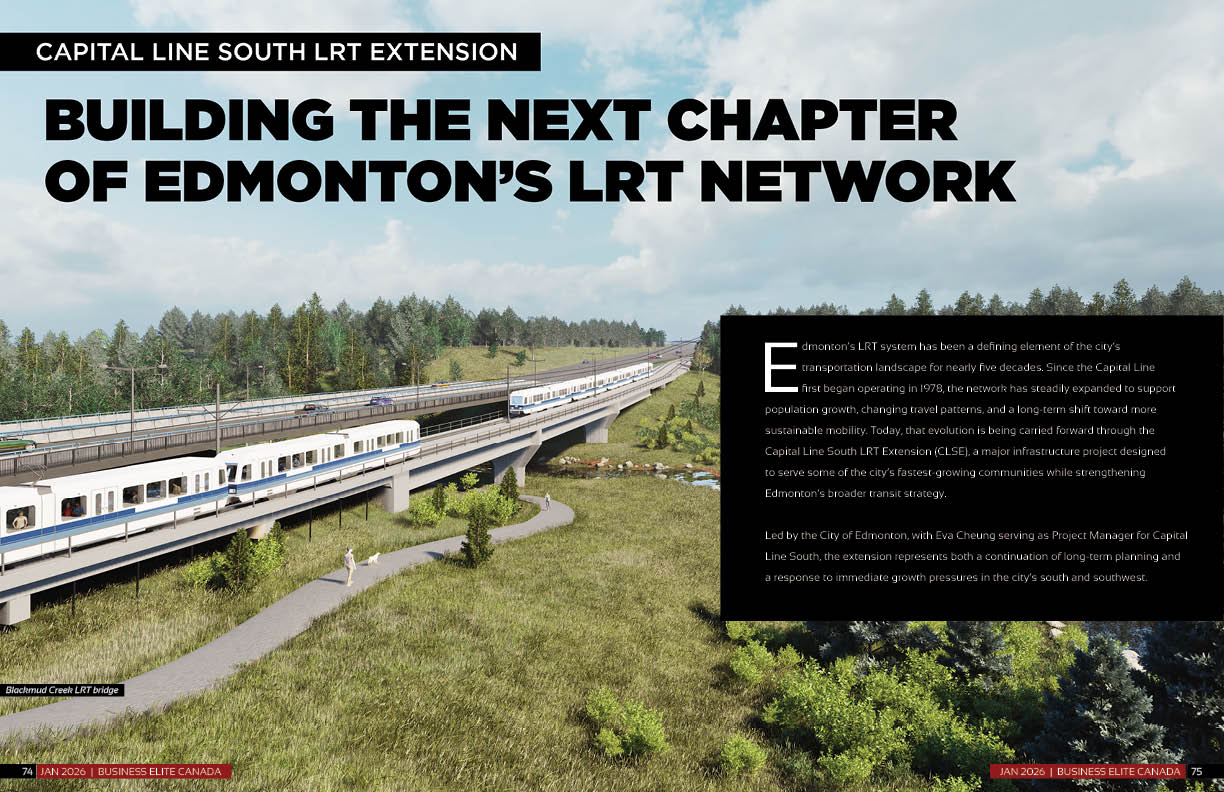
Key elements include an LRT underpass at the busy intersection of 23 Avenue and 111 Street, two major bridges crossing Blackmud Creek and Anthony Henday Drive, and two new LRT stations. The Twin Brooks LRT Station is a smaller, neighbourhood-scale stop designed to serve nearby residential communities, while Heritage Valley North LRT Station is a larger, multi-modal hub directly connected to the existing Heritage Valley Transit Centre and Park & Ride facility.
Supporting long-term operations is the new Llew Lawrence Operations and Maintenance Facility, a 230,000-square-foot complex south of Anthony Henday Drive that will store and maintain trains for the expanding high-floor LRT network.
“All of these key elements are designed to work together,” says Cheung. “They improve efficiency, support long-term operations, and ensure stations connect seamlessly with pedestrian and cycling networks.”
Integrating with Existing Transit
Once the extension opens, the surrounding bus network will be restructured to maximize efficiency and convenience for the Edmonton southwest area. Many routes south of Anthony Henday Drive and along 111 Street will be shortened to connect directly with Heritage Valley North LRT Station.
This integration is expected to reduce travel times for commuters heading downtown or to the University of Alberta, ease congestion at Century Park Transit Centre, and free up buses and service hours that can be reinvested elsewhere in the city. It will also significantly reduce the number of buses operating along the busy 111 Street corridor.
Managing Cost and Complexity
Additional funding was approved in 2024 in response to rising construction tender values, inflationary pressures, and ongoing market volatility, challenges faced by major infrastructure projects across Canada.
The total project budget, including new light rail vehicles for the Capital Line and Metro Line, now stands at $1.39 billion. Funding is shared among the Government of Canada ($431 million), the Government of Alberta ($372 million), and the City of Edmonton ($589 million).
Construction Progress and Challenges
Constructing an LRT line through an active urban corridor presents significant logistical challenges. Much of the work is taking place along 111 Street, one of Edmonton’s busiest arterial roads, requiring careful staging to maintain traffic flow and neighbourhood access.
A particularly complex milestone was the implementation of a major lane shift at the 23 Avenue and 111 Street intersection in fall 2024. This intersection serves more than 26,000 vehicles on an average weekday and required precise coordination for the major lane shift, which was necessary for construction to start on the LRT underpass.
Throughout 2025, work has progressed across multiple sites along the 4.5-kilometre extension. Piling has been completed for the south portal of the LRT underpass, as well as for the Blackmud Creek LRT bridge. Earthworks are underway at Twin Brooks LRT Station, foundational work is complete at the operations and maintenance facility, and preparations are advancing at Heritage Valley North LRT Station. Major bridge installations over Blackmud Creek and Anthony Henday Drive are anticipated in 2026.
Communities Along the Corridor
Community outreach has remained a central focus throughout construction. The City and Ledcor employ a multi-layered approach that includes regular construction notices, targeted outreach to schools and businesses, participation in community events and community leagues, and quarterly meetings with a Community Advisory Committee established during the preliminary design phase.
Seasonal communications provide residents and businesses with clear expectations at the start of each construction season, followed by year-end summaries outlining progress and upcoming work.
Looking Ahead
Major construction is expected to continue for four to five years, followed by testing and commissioning before passenger service begins. Procurement for new high-floor light rail vehicles is underway, and the preferred proponent (Hyundai Rotem Company) was recently announced in late 2025. New vehicles are expected to be delivered in 2029/ 2030.
While Phase 2 remains unfunded, preliminary design is complete and land has been secured. Advancement will depend on future funding commitments from other levels of government.
For Cheung, the Capital Line South LRT Extension represents Edmonton’s broader shift toward an urban-style LRT system, with closer station spacing, improved connections to neighbourhoods, and accessible infrastructure designed to be part of daily city life. As construction continues, the Capital Line South LRT Extension is steadily reshaping how Edmonton moves, laying the groundwork for a more connected and resilient future.
“The goal is easier access, better connections, and a system that grows with the city,” says Cheung.
For more information, please visit www.edmonton.ca/projects_plans/transit/capital-line-south