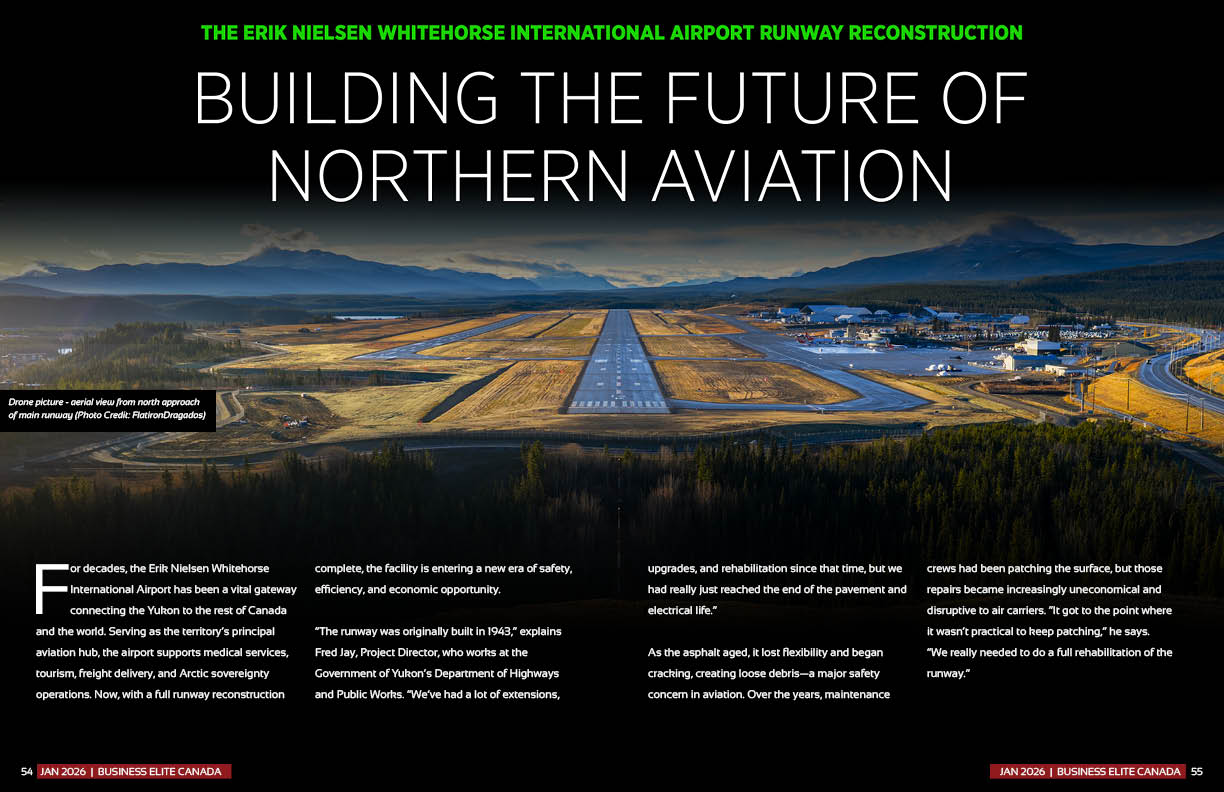
For decades, the Erik Nielsen Whitehorse International Airport has been a vital gateway connecting the Yukon to the rest of Canada and the world. Serving as the territory’s principal aviation hub, the airport supports medical services, tourism, freight delivery, and Arctic sovereignty operations. Now, with a full runway reconstruction complete, the facility is entering a new era of safety, efficiency, and economic opportunity.
“The runway was originally built in 1943,” explains Fred Jay, Project Director, who works at the Government of Yukon’s Department of Highways and Public Works. “We’ve had a lot of extensions, upgrades, and rehabilitation since that time, but we had really just reached the end of the pavement and electrical life.”
As the asphalt aged, it lost flexibility and began cracking, creating loose debris—a major safety concern in aviation. Over the years, maintenance crews had been patching the surface, but those repairs became increasingly uneconomical and disruptive to air carriers. “It got to the point where it wasn’t practical to keep patching,” he says. “We really needed to do a full rehabilitation of the runway.”
The electrical systems had also reached the end of their lifespan, with cables frequently developing faults after frost cycles. “We decided to do a full rehab of basically everything,” says Jay.
Building in a Northern Climate
Karine Potvin, Project Coordinator, describes aviation as “the lifeline for northern communities,” emphasizing that it supports everything from medical transportation to tourism and national security. “Our airport serves roughly 400,000 passengers per year,” she says. “These upgrades are crucial to improving safety and modernizing our infrastructure to support the long-term economic growth of the territory.”
Work began in 2022 with the replacement of the aging apron concrete and the expansion of the parallel runway. That early investment proved critical later, enabling the airport to handle larger aircraft and nighttime operations during the main runway closures.
“Main runway work started in 2023,” Potvin continues. “We began with site preparation, including ground clearing and the construction of our service road and utilities. From May to October 2024, we completed upgrades on the north half of the runway—rebuilding the asphalt surface, installing new drainage systems and edge lighting, constructing a new taxiway, and upgrading electrical systems.” The second phase, covering the south half of the runway, followed in 2025, completing the reconstruction.
Among the most significant challenges was the region’s short construction season. “We have a relatively short window compared to other areas of Canada,” says Jay. “That’s part of why we decided to rebuild the main runway in two phases: the north half in 2024 and the south in 2025.”
Because the airport’s main runway is the only one equipped with an instrument landing system, it needed to be reopened for winter operations between phases. “We had to have everything buttoned up before October 15,” says Jay. “That meant being completely dialed in with our contractor on material deliveries and scheduling.”
Engineering the new runway also required innovation. “We had to basically line up a brand-new runway with an old runway and make them mesh together,” says Jay. Integrating new and legacy systems presented challenges, especially with the airfield lighting, which had to be adapted to ensure functionality and safety.
The region’s climate added another layer of complexity. “We can see +30°C in the summer and -40°C or -50°C in the winter,” says Jay. “Our consulting team took special care in designing the asphalt mix to withstand those temperature swings. We even added fibers to the mix to minimize cracking and prevent debris formation.” The result is a surface expected to last at least 25 years before major rehabilitation is needed.
Partnerships and Logistics
Delivering a project of this magnitude in the North required extraordinary coordination among suppliers, contractors, and governments. “While we may appear remote on a map, Whitehorse is actually a significant connector for communities throughout the Yukon, Northwest Territories, and Alaska,” says Potvin.
The project benefited greatly from strong local partnerships, including with Yukon First Nation governments. “A large amount of the fuel, aggregates, and trucking were provided by Yukon First Nation–owned companies,” says Potvin. “That was exciting and really contributed to the project’s success.”
Distance from major cities was still a logistical challenge, demanding careful planning and flexibility from all partners to minimize disruptions. “Despite Whitehorse’s connectivity, we still had to be strategic in our scheduling and supply management,” Potvin adds.
Fred notes that changing weather patterns were an emerging factor in the airport’s infrastructure planning. “A decade or so ago, Whitehorse only had a couple of freeze-thaw cycles a year,” Jay explains. “Now we’re getting more of those cycles, especially in the shoulder seasons, which makes the pavement move and crack.”
To counteract this, the design team included additional drainage systems beneath the runway. “Before reconstruction, we installed sub-drains around the perimeter to get as much water out of the base surface as possible,” Jay says. “That helps prevent frost movement from uneven freezing.”
Investing in the Yukon’s Future
Karine credits the project’s success to extensive collaboration between the Government of Yukon, Yukon First Nations, contractors, and the federal government. “Our general contractor was Flatiron Dragados Corporation, and our main consultant was Associated Engineering,” Potvin says. “Both worked tirelessly to ensure the project was completed successfully.”
Crucially, the project was supported by $186.2 million in federal funding through Transport Canada’s National Trade Corridors Fund. “That funding gave us flexibility to adjust the schedule and reduce the impact on travelers and carriers,” Potvin notes. “It was a huge part of what made this project successful.”
To minimize disruptions, the airport extended and upgraded its parallel runway before construction began on the main one. “That was the biggest change we made to keep things moving,” Jay explains.
Still, the construction site was active while aircraft crossed between the terminal and the secondary runway. “There was a lot of coordination between our crews, airport operations, and the control tower,” Jay says. “We had to reduce access points, manage a mix of large commercial jets and small general aviation planes, and constantly sweep and clean crossings. But it worked well. There were no safety incidents and minimal impact to travelers.”
The new runway will have far-reaching benefits for the Yukon’s economy and connectivity. “Aviation is our lifeline to the south,” says Jay. “We’re a couple of hours by air from Vancouver or Edmonton, but it’s a 20- to 30-hour drive. The airport is essential not just for passengers, but for medical transfers, wildfire operations, and the supply chains that keep our industries running.”
He notes that reliable air access directly supports mining, tourism, and resource development. “These upgrades position us to offer a more secure and dependable connection to the rest of Canada and the world,” he says.
For Potvin, the project also held personal significance. “I feel fortunate to have been part of it,” she says. “This is a major piece of infrastructure that my family and community will use for decades. It’s rare to work on something that has such a lasting impact.”
From its 1940s origins to its modern transformation, the Erik Nielsen Whitehorse International Airport runway reconstruction represents both progress and continuity, and a vital investment ensuring the North remains connected, and ready for the future.
For more information about the runway reconstruction project, please visit Yukon.ca.
For information about Transport Canada’s National Trade Corridor Fund, visit
https://tc.canada.ca/en/programs/funding-programs/national-trade-corridors-fund.