The reconstruction of the Île-aux-Tourtes bridge stands as one of the most significant transportation infrastructure projects currently underway in Quebec. Valued at $2.3 billion and fully funded by the Government of Quebec, the project is designed to secure the long-term reliability of Highway 40, the biggest highway connection between the Island of Montreal and the Vaudreuil-Soulanges region.
“The reconstruction of the Île-aux-Tourtes bridge addresses the priority need to maintain the sustainability and safety of the inter-shore link spanning Lake of Two Mountains along Highway 40 between the Island of Montreal and the Vaudreuil-Soulanges region,” says Julie Grondin, Project Director for the Ministère des Transports et de la Mobilité durable.
Beyond replacing an aging structure, the project is intended to modernize mobility, strengthen economic connections, and integrate sustainability principles into every phase of delivery.
Scope, Scale, and Strategic Objectives
While the new bridge itself will be approximately two kilometres long, the overall scope of work extends over roughly 4.5 kilometres. This includes the reconstruction of Highway 40 approaches, the addition of new side lanes, and the reconfiguration of entrances and exits in the Senneville area. A new multi-use path and its connections are also part of the broader works.
“With this project, the Ministry has set itself the challenge of ensuring the mobility of people and goods along Highway 40, promoting active and public transportation, and showcasing the infrastructure through its integration into the landscape,” Grondin explains.
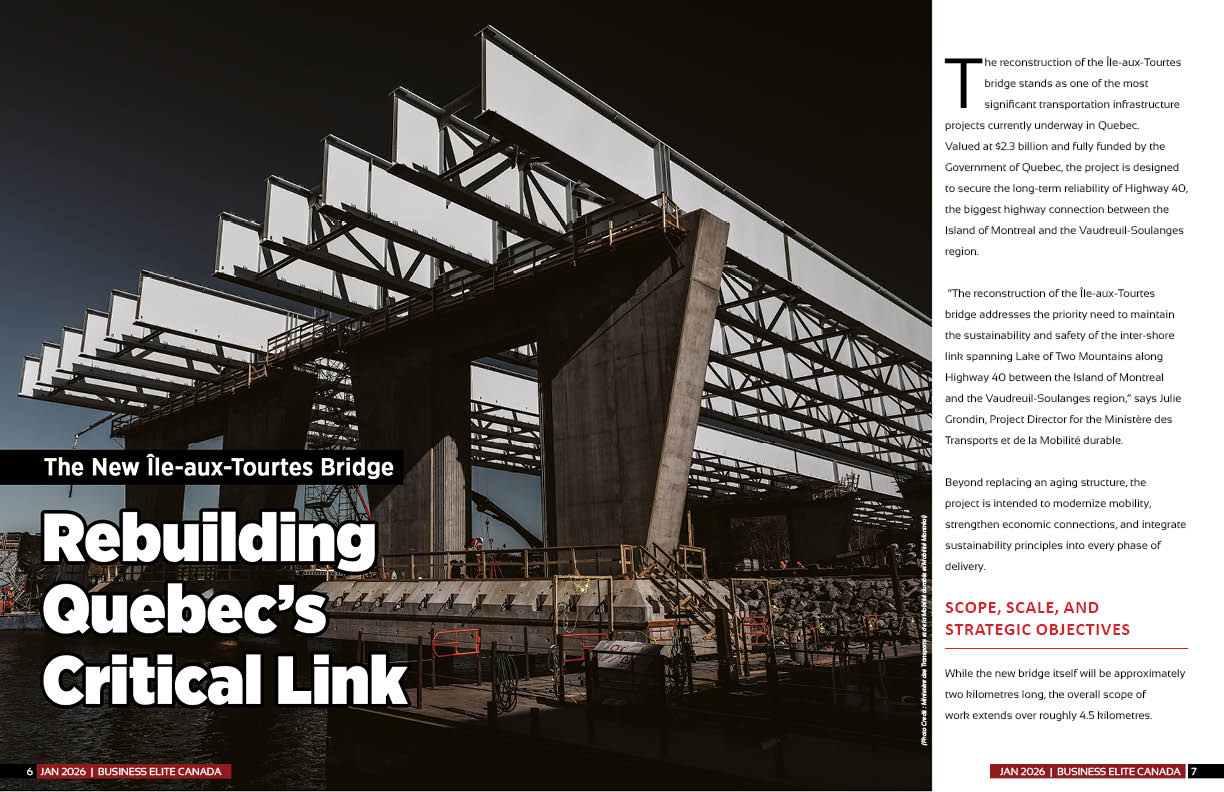
The new bridge will be built north of the existing structure and will feature three traffic lanes in each direction. Right-hand shoulders will be adapted for bus use to facilitate public transit movement during periods of congestion, while a two-way multi-use path will be constructed on the westbound deck. The project scope also includes demolition of the existing bridge and architectural enhancements to the new structure.
Designing for Durability and Safety
The design of the new Île-aux-Tourtes bridge reflects decades of operational experience with the existing structure, which opened in 1965. Over time, freeze-thaw cycles, corrosion, and increasing traffic loads contributed to accelerated deterioration of the original bridge’s slabs and beams.
“These recurring interventions clearly demonstrated that the structure had reached the end of its useful life,” Grondin notes
The new bridge is being delivered in accordance with the Ministry’s latest standards and best practices. “The replacement of the structure is carried out according to best practices and the latest standards of the Ministry, which guarantees a durable and safe structure,” she says.
Wider lanes and shoulders have been incorporated to improve usability and simplify maintenance operations, helping to reduce future disruptions to traffic.
Materials, Structure, and Long-Term Viability
Sustainability and longevity are central to the project’s technical approach. The new structure will consist of two parallel and independent decks separated by approximately five metres, a configuration that facilitates inspections and future maintenance. Steel beams topped with reinforced concrete slabs will create a redundant structural system familiar to the Ministry, which oversees more than 10,000 bridge structures across the province.
“The type of structural system used for the existing bridge is no longer part of the Ministry’s practices, particularly given the challenges related to repair and maintenance,” Grondin explains.
Durable materials have been prioritized throughout the design. “As part of its project, the Ministry prioritizes the use of sustainable materials, including high-performance concrete, galvanized steel reinforcement, and a waterproofing membrane for the deck,” she adds.
Although the Ministry initially required a minimum lifespan of 75 years, the final design significantly exceeded expectations. “The contractor was able to enhance the structural elements to the Ministry’s satisfaction, resulting in a structure with a lifespan of 100 years,” Grondin says.
Climate Adaptation and Future Resilience
Climate change considerations have also shaped key design decisions. The vertical clearance of the new bridge will increase from 13 metres to 15.2 metres, a change intended to mitigate flood risks and improve resilience over the coming decades.
“This increased vertical clearance is a measure to adapt to climate change and address flood risks, ensuring the infrastructure’s longevity,” Grondin explains. The additional clearance also improves navigability for sailboats that previously had to lower their masts to pass beneath the bridge.
Improving Mobility and Operational Reliability
The new bridge will meet the current and future needs of users. In 2023, traffic volumes reached approximately 81,000 vehicles per day, with trucks accounting for 10 percent of total traffic.
“By providing a new structure for users of the Île-aux-Tourtes bridge, the Ministry ensures the reliability of this inter-river link in the axis of Highway 40,” Grondin says.
The bridge will include right-hand shoulders adapted for bus use, improving public transit efficiency during congestion, as well as a three-metre left shoulder to enhance safety in the event of a breakdown. Traffic lights and an extended fibre optic network will support improved traffic management and faster incident response.
“This extension will be implemented with redundancy, meaning there will be two parallel fibre optic paths to ensure at least one connection is always maintained,” Grondin notes, reinforcing system reliability.
Multimodal Connectivity and Active Transportation
Multimodal transportation is a defining feature of the project. After extensive analysis with regional transit agencies, wide shoulders adapted for buses were identified as the most effective measure to support public transit.
“The measure offering the greatest added value for public transit on the Île-aux-Tourtes bridge is a wide shoulder adapted for bus use,” Grondin says.
Active transportation is also prioritized. The new multi-use path and viewpoints will connect to existing cycling networks, creating a new crossing for pedestrians and cyclists. A corridor has also been preserved to accommodate a potential future heavy transportation mode, should government authorities choose to implement one.
Environmental Protection at an Exceptional Scale
Environmental protection is embedded into every phase of the project. Located near Île aux Tourtes, the site includes sensitive aquatic environments, wetlands, forests, and protected wildlife habitats.
“Environmental protection is an integral part of the project,” Grondin emphasizes.
The project is subject to Quebec’s environmental impact assessment process and includes extensive mitigation, restoration, and compensation measures. These include one of the largest freshwater mussel relocation efforts in the province, the protection of peregrine falcons and white-fronted swallows nesting on the bridge, and compensation plans for fish habitats, forested areas, migratory birds, and turtle populations.
The project is also pursuing Envision Platinum recognition, reflecting the Ministry’s commitment to third-party evaluation of sustainable infrastructure performance.
Supporting Economic Vitality
As the biggest highway link between Montreal and the Vaudreuil-Soulanges region, the bridge plays a vital role in regional and international trade. “Sixty percent of trucks travelling between the Greater Montreal area and Ontario use the bridge,” Grondin notes.
By maintaining this strategic corridor, the project supports freight mobility, interregional connectivity, and long-term economic activity across Quebec and beyond.
“The project aimed at maintaining this link contributes positively to local, regional, and international economic exchanges,” Grondin says. “It will therefore support long-term economic vitality.”
For more information, please visit www.quebec.ca/gouvernement/ministeres-organismes/transports/coordonnees-structure/generales?