“The land surrounding the Chaudière Falls is a sacred meeting place for the Anishinābe Algonquin Nation and other First Nations,” Gasperetti says. “The partnership, formed from engagement with local communities, led to significant design inspiration and a commitment that the facility would be home to ongoing engagement and collaboration.”
A contemporary wigwam-inspired lodge and children’s area will serve as a circular space for storytelling traditions, meeting and teaching. Indigenous gardens and a gathering circle will extend the facility’s purpose outdoors, linking it to its natural and cultural setting.
Wayfinding throughout the building will feature Anishinābemowin Algonquin alongside French and English, underscoring the facility’s commitment to reconciliation and accessibility.
Progress on construction
Construction, led by PCL Constructors Canada Inc., is at an intricate phase and is already transforming LeBreton Flats, with visible progress evident inside and out.
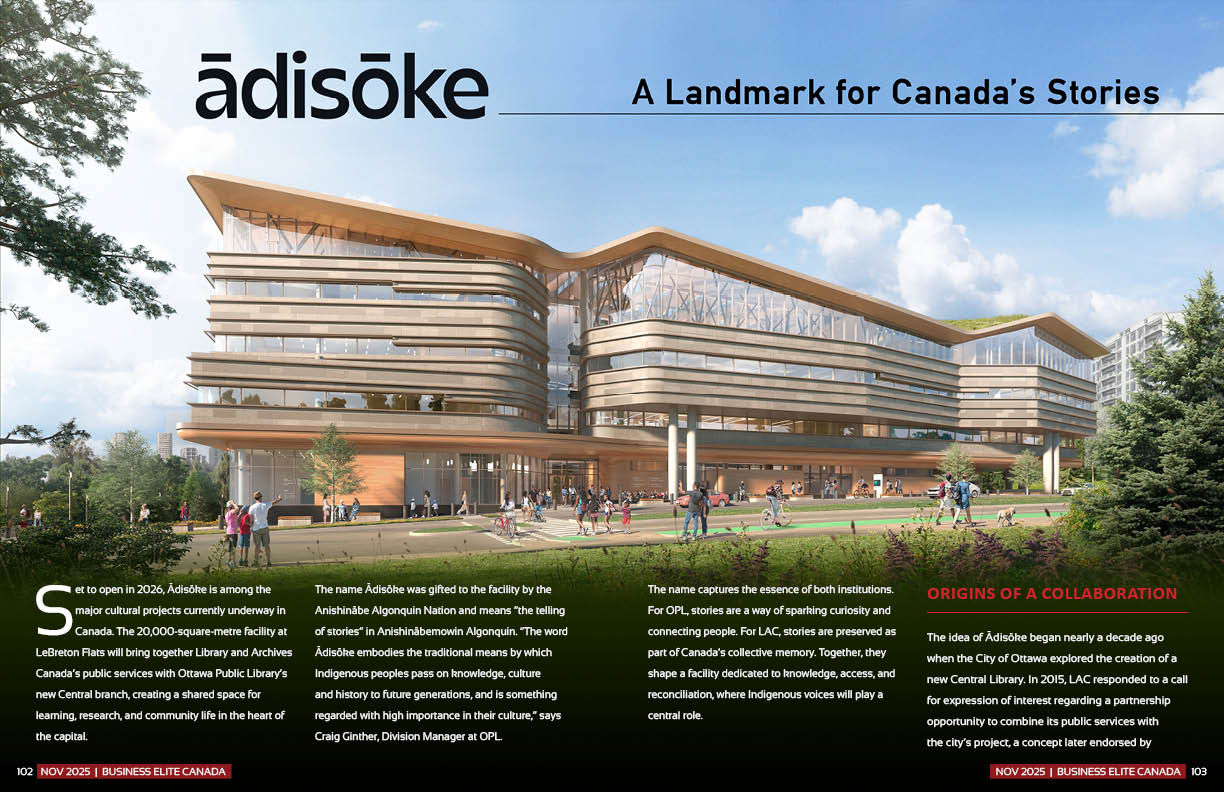
“The year ahead will be filled with activity and excitement as we build momentum toward the grand opening,” says Tara Blasioli, Manager of Ādisōke at the City of Ottawa. “Finishing touches continue on the roof, while intricate wood and stonework are adding character to the façade of the landmark facility. Solar panels have been installed along the exterior walls. Some days they may appear bright and iridescent, while others they look darker and matte.”
Within the building, trades are installing custom millwork, curved glass walls, and advanced electrical and mechanical systems. The central atrium, designed to flood the space with daylight, is taking shape as one of the facility’s most distinctive features.
Economic and cultural benefits
When complete, Ādisōke is expected to draw more than one million visitors each year. Its scale and location will make it a new focal point in Ottawa, with ripple effects on local businesses and tourism.
“As the new home of OPL’s Central branch and the main location for LAC’s public services, Ādisōke will be a landmark destination providing lasting economic and community development benefits for Ottawa and the surrounding region,” says Ginther.
Events, exhibitions, and cultural programming animate the building year-round. Its presence at LeBreton Flats is expected to stimulate new development in the area while reinforcing Ottawa’s status as a national capital with international-caliber cultural spaces.
Commitment to sustainability
For an executive audience, one of the most striking aspects of Ādisōke is its environmental performance. The project has been designed to achieve net-zero carbon and has already received Zero Carbon Building Design certification from the Canada Green Building Council.
“The Government of Canada, LAC, City of Ottawa, and OPL are committed to creating a sustainable, state-of-the-art cultural facility, and Ādisōke is leading the way in sustainable infrastructure development,” Gasperetti adds.
Sustainability features include solar panels, upgraded insulation, triple-glazed windows, green concrete, and a green roof. It connects to the federal government’s district energy system, incorporates bird-friendly glass, and uses Indigenous plants in the landscaping to reduce environmental impact. Indoors, visitors will find abundant daylight and even a vertical garden.
More than a building
For its partners, Ādisōke is ultimately about rethinking how Canadians engage with stories, knowledge, and identity.
“Ādisōke will bring together, under one roof, the vast collections and expertise of OPL and LAC,” Ginther says. “It will be more than a building; it will be a meeting place to encounter the past, understand the present, and shape the future.”
The blending of OPL’s role in fostering community life with LAC’s mission to connect people with Canada’s memory creates a new type of institution. By situating Indigenous knowledge alongside federal and municipal collections, Ādisōke will offer a richer, more inclusive understanding of Canada.
Looking toward opening day
As the opening draws closer, the anticipation is evident among all partners.
“This public facility will offer stunning, accessible space, available for everyone to enjoy and will welcome our local community and visitors from around the world,” says Ginther. “Kids discovering the children’s centre, teens finding their own space, researchers accessing world-class collections, and everyone learning, creating, and connecting. That’s the vision we’re building toward.”
Ādisōke is on track to become a place where past and present converge, where reconciliation and sustainability guide design, and where stories remain at the center. When the doors open, Canadians will step into a facility built to serve generations, carrying forward the meaning its name describes: the telling of stories.
For more information, please visit www.adisoke.ca