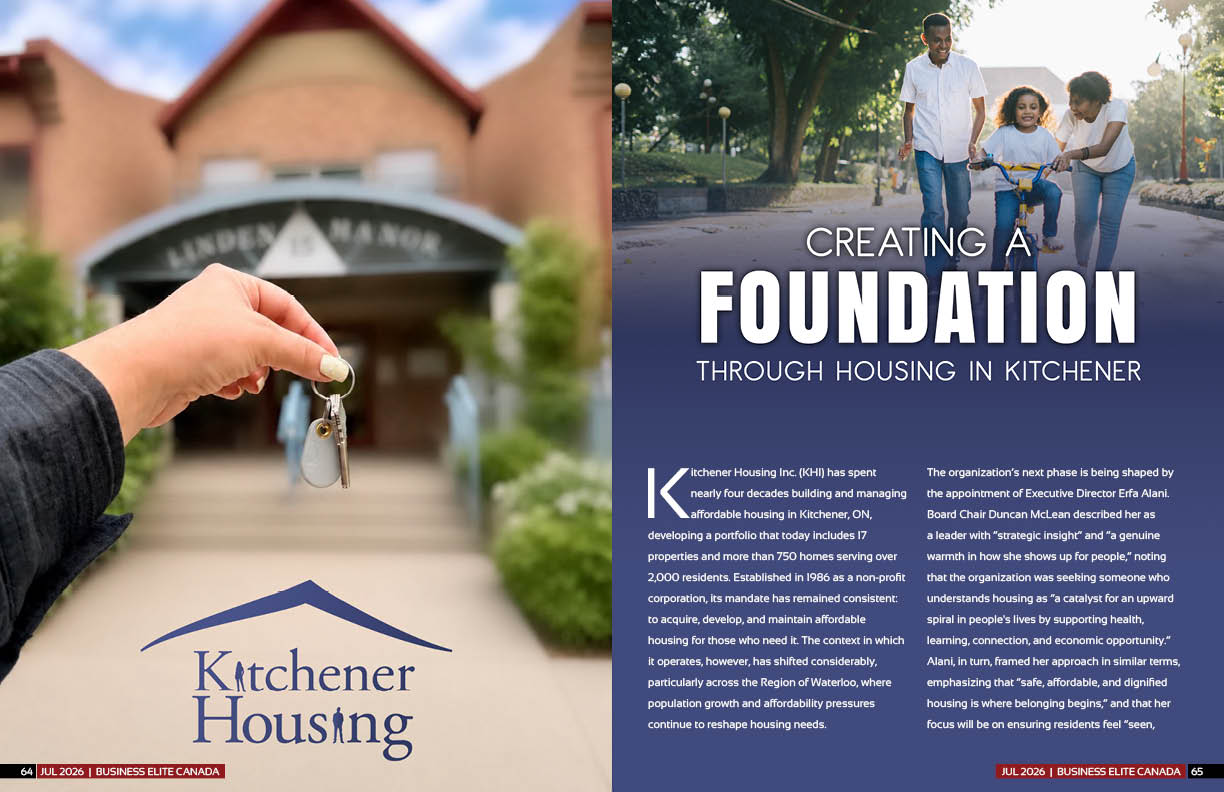
Kitchener Housing Inc. (KHI) has spent nearly four decades building and managing affordable housing in Kitchener, ON, developing a portfolio that today includes 17 properties and more than 750 homes serving over 2,000 residents. Established in 1986 as a non-profit corporation, its mandate has remained consistent: to acquire, develop, and maintain affordable housing for those who need it. The context in which it operates, however, has shifted considerably, particularly across the Region of Waterloo, where population growth and affordability pressures continue to reshape housing needs.
The organization’s next phase is being shaped by the appointment of Executive Director Erfa Alani. Board Chair Duncan McLean described her as a leader with “strategic insight” and “a genuine warmth in how she shows up for people,” noting that the organization was seeking someone who understands housing as “a catalyst for an upward spiral in people’s lives by supporting health, learning, connection, and economic opportunity.” Alani, in turn, framed her approach in similar terms, emphasizing that “safe, affordable, and dignified housing is where belonging begins,” and that her focus will be on ensuring residents feel “seen, respected, and supported in every building we operate.”
A Foundation for Stability
Kitchener Housing’s scale and reach reflect both longevity and steady growth. As Alani explains, the organization today operates a mix of apartments and townhomes that range from bachelor units to four-bedroom family housing.
That range is deliberate. Housing needs are not uniform, and KHI’s portfolio reflects the reality that residents arrive at different stages of life and with different expectations for how long they will stay. Some require temporary stability, while others depend on long-term affordability and consistency.
Alani describes housing as more than shelter, calling it “the platform that allows people to build stability, health, and opportunity in their lives.” In practice, that translates into a model that prioritizes both physical housing and the conditions that allow residents to move forward. For some, she notes, stable housing can function as “an upward catalyst,” creating the space to find work, complete education, or rebuild after disruption. For others, it provides an enduring sense of safety and belonging.
This perspective informs KHI’s broader philosophy. Rather than applying a single model to all residents, the organization emphasizes adaptability. Its role is to provide a foundation that can support different outcomes, depending on what stability enables for each household.
Evolving Role in a Changing Sector
Like many housing providers, KHI began with a more traditional focus on acquiring and managing affordable homes. That core responsibility remains, but the organization’s role has expanded as expectations around housing have changed.
Alani notes that the sector increasingly understands housing as part of a wider system tied to health, well-being, and economic participation. This has shifted the focus beyond buildings themselves toward how residents connect to services, neighbourhoods, and support networks.
Tenant demographics have also evolved. KHI is now serving a more varied population that includes newcomers and refugees, individuals affected by the mental health and drug crisis, and residents still dealing with the long-term effects of the pandemic. These changes require a more responsive approach, one that extends beyond maintenance and rent administration into coordination with external services and community partners.
“The defining milestones are not just growth in units (which we have had and have ambitious plans for more), they are also the shift from landlord to steward of important public assets, from housing provider to community partner, and from a narrower operational role to a broader responsibility,” says Alani.
Operating in a Constrained Environment
The pressures facing KHI mirror those seen across the affordable housing sector, though they are often more immediate at the local level. Demand continues to rise, while the cost of delivering and maintaining housing has increased across nearly every category.
Alani describes the organization as managing “aging housing stock” alongside “significant capital needs,” while also pursuing an “ambitious growth strategy.” This creates a dual requirement: reinvest in existing properties while identifying opportunities to expand. Both objectives are affected by broader market conditions, including rising construction costs, insurance, utilities, and ongoing uncertainty tied to labour shortages and material pricing.
At the same time, tenant needs have become more complex. Housing providers are increasingly responding to challenges that extend beyond housing itself, including mental health pressures and reduced access to community supports. An aging tenant population introduces additional requirements for accessibility and retrofits, particularly for those seeking to remain in place over the long term.
Digital access has also emerged as a factor. As more services shift online, gaps in digital literacy and access to devices or affordable internet can limit residents’ ability to navigate housing systems, benefits, and employment opportunities.
Operational constraints further complicate the environment. Delays within the Landlord and Tenant Board system can extend timelines for resolving serious issues, creating financial and administrative strain for providers who must carry those challenges over longer periods.
KHI’s response centres on prioritization and partnerships. Alani points to the importance of “stronger capital planning, better data, and sharper prioritization,” alongside efforts to pursue funding for both growth and retrofits. Sustainability-related funding, in particular, is seen as a way to modernize buildings while reducing long-term operating costs.
Growth, Partnerships, and Community Impact
The effects of affordable housing extend beyond individual residents, shaping outcomes across the broader community. “Affordable housing strengthens the whole community because it creates the stability everything else builds on,” said Alani. “It supports children and schools because when families have stable housing, children are more likely to attend school consistently, be ready to learn, have better relationships with peers and do better over time. It supports public safety because stable housing reduces crisis, lowers pressure on emergency systems, and helps create more orderly, connected neighbourhoods.It supports the economy by making is possible for people to live near work, keep jobs, and participate in community life.”
“Affordable housing does not just help one family. It strengthens the whole community and we all benefit.”
KHI’s approach to growth reflects these interconnected impacts. Rather than relying solely on traditional development models, the organization is exploring a range of options, including partnerships and alternative construction methods such as modular housing. These approaches may allow for increased density on existing sites, as well as more efficient delivery of new units.
Land and existing assets play a central role in this strategy. By examining where intensification or redevelopment is possible, KHI is looking to expand capacity without relying exclusively on new land acquisition. This requires careful planning, particularly in balancing the needs of current residents with future growth.
“Partnerships are essential,” says Alani. “Affordable housing cannot be delivered in isolation. By working with governments, developers, service organizations, and community groups, we amplify our impact and create more holistic support systems for residents.”
At the resident level, the impact of this work is often visible in incremental but meaningful ways. Alani describes how stable housing can shift the focus within a household from immediate survival to longer-term planning, allowing parents to concentrate on routines, education, and stability. For seniors, it can mean remaining in place with safety and dignity, while for newcomers it can provide a starting point from which other aspects of life begin to stabilize.
“The work we do feels very human up close,” said Alani. “The parent who can finally breathe. Housing changes the conversation at home. It becomes less about survival and more about getting children to school, keeping appointments, planning ahead. It’s about creating the conditions for ordinary life to become possible again.”
For more information, please visit https://kitchenerhousinginc.ca/