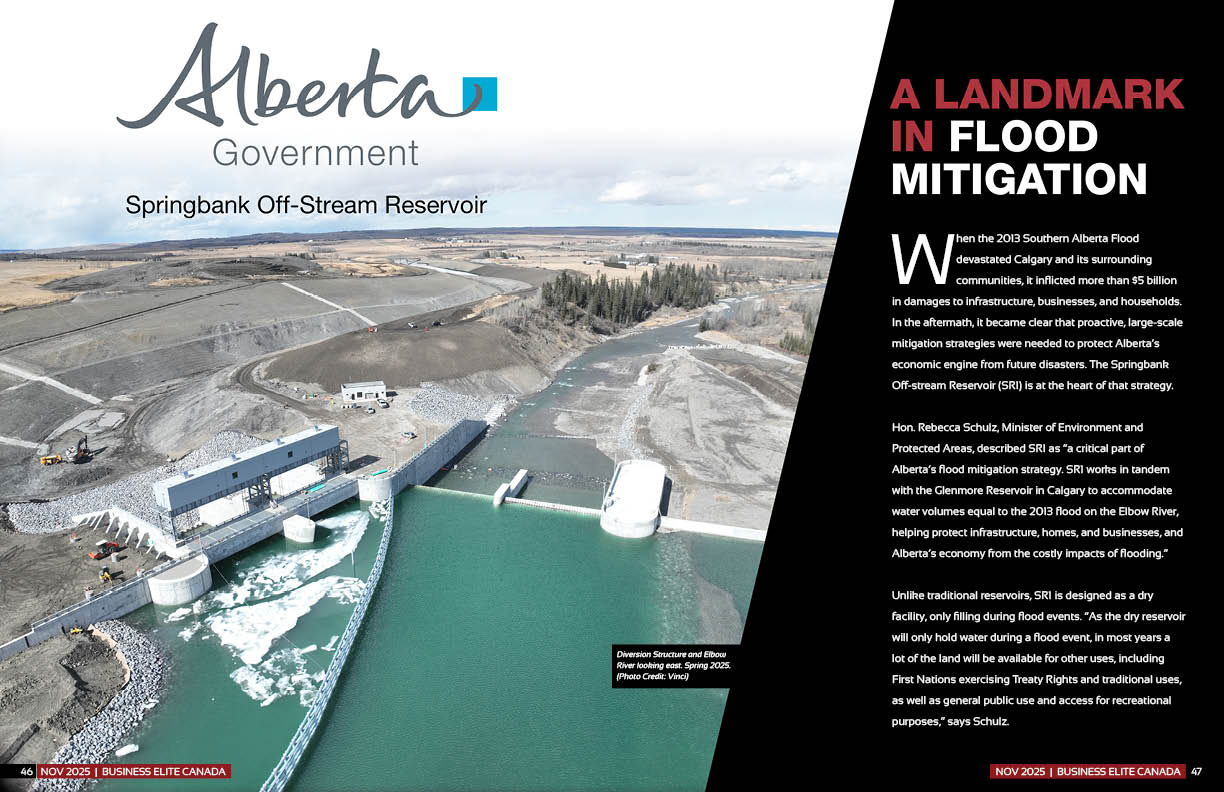
When the 2013 Southern Alberta Flood devastated Calgary and its surrounding communities, it inflicted more than $5 billion in damages to infrastructure, businesses, and households. In the aftermath, it became clear that proactive, large-scale mitigation strategies were needed to protect Alberta’s economic engine from future disasters. The Springbank Off-stream Reservoir (SR1) is at the heart of that strategy.
Hon. Rebecca Schulz, Minister of Environment and Protected Areas, described SR1 as “a critical part of Alberta’s flood mitigation strategy. SR1 works in tandem with the Glenmore Reservoir in Calgary to accommodate water volumes equal to the 2013 flood on the Elbow River, helping protect infrastructure, homes, and businesses, and Alberta’s economy from the costly impacts of flooding.”
Unlike traditional reservoirs, SR1 is designed as a dry facility, only filling during flood events. “As the dry reservoir will only hold water during a flood event, in most years a lot of the land will be available for other uses, including First Nations exercising Treaty Rights and traditional uses, as well as general public use and access for recreational purposes,” says Schulz.
Building Economic Resilience
The $850 million price tag reflects more than the urgency of flood protection; it underscores Alberta’s long-term commitment to safeguarding its economy and communities. Proactive measures are always more cost-effective than rebuilding after disaster. “In this case, proactive flood mitigation like SR1 is far more cost-effective than post-disaster recovery and rebuilding,” says Schulz.
She added that minimizing risk for businesses and homeowners also stabilizes the broader economy: “Reducing the risk of catastrophic flood damage, SR1 safeguards homes, businesses, and critical infrastructure, minimizing costly emergency responses and service disruptions.”
SR1 also provided an employment boost during construction. At its peak, about 500 workers were engaged in roles spanning skilled trades, engineering, environmental monitoring, and support services. Opportunities extended to Indigenous communities as well. Nine First Nations participated as environmental monitors and contributed to cultural training, creating both jobs and long-term expertise.
Why SR1 Was the Best Option
Flood mitigation alternatives such as McLean Creek and Bragg Creek were fully studied before SR1 was selected. The conclusion was clear: SR1 offered the best balance of protection, integration, and environmental outcomes. “It was clear that the SR1 project offered broader regional protection for Calgary and surrounding communities, unlike the Bragg Creek option,” Schulz explains. “SR1 also offered fewer environmental risks than the McLean Creek option, and ultimately would better integrate with existing infrastructure and emergency systems.”
That integration has become a defining feature. Rather than acting in isolation, SR1 works in tandem with the Glenmore Reservoir. Together they create a two-tiered system—SR1 captures peak floodwaters upstream, while Glenmore fine-tunes water levels within Calgary. Schulz called this coordination “quite sophisticated” and emphasized that it allows for adaptive responses to shifting conditions in real time.
There is also a strong environmental dimension to this operational strategy. Careful water management not only protects urban assets but also reduces riverbank erosion and shields aquatic habitats. As Schulz noted, “Carefully managed water releases help minimize riverbank erosion and protect aquatic habitats, balancing flood mitigation with environmental stewardship.”
Collaboration with Indigenous Communities
From the outset, Indigenous knowledge shaped how SR1 was planned and built. Schulz said she was “so grateful for the participation and contribution of the First Nations. Treaty 6 and Treaty 7 First Nations from nine different communities participated as environmental monitors, contributing traditional knowledge and cultural insight throughout the project.”
One of the most important contributions was the principle of “resting and healing the land” for two years after construction or any flood event. This practice, along with the establishment of a First Nations Land Use Plan Implementation Committee, ensures that traditional perspectives continue to guide stewardship long after construction is complete.
Environmental mitigation was another core priority. SR1 was deliberately designed to reduce disruption to the Elbow River’s natural flow, protecting fish populations and aquatic habitats. Regulatory processes required detailed plans for managing potential impacts on water quality, wildlife, and vegetation, and these plans were reviewed by Indigenous groups as well as government regulators before construction began.
“The area is closed to unauthorized access for at least two full growing seasons after construction,” Schulz explains, “allowing vegetation time to regenerate and give wildlife time to adapt to the altered landscape. Environmental monitoring was conducted throughout construction and continues during operations to ensure long-term protection of the environment.”
Looking Ahead
With construction complete, attention now shifts to how SR1 lands will be used in the years ahead. The land use plan strikes a balance between treaty rights, ecological stewardship, and limited recreation. “The plan designates the area as Crown land, allowing First Nations to exercise Treaty Rights and engage in traditional practices,” Schulz said. While it is not intended as a recreational hub, low-impact activities such as walking, cycling, and hunting will be permitted in designated areas.
The focus remains on ecological protection, through measures such as vegetation management, wildlife-friendly fencing, and ongoing environmental monitoring. Importantly, ongoing operational costs are already covered: “Operations and maintenance for SR1 fall within the Ministry of Agriculture and Irrigation’s existing budgets.”
For Alberta’s business community, SR1 provides protection against the financial and operational shocks of natural disasters. It reinforces economic stability across the region while also demonstrating how government and Indigenous partners can work together on shared priorities.
For more information, please visit www.alberta.ca/springbank-off-stream-reservoir